The National Association of Realtors (NAR) is set to release its latest Existing Home Sales (EHS) report, which provides insights into the sales volume and price trends of previously owned homes. However, there may be some confusion when the report reveals a decline in home prices, especially in light of other blogs claiming that home prices have reached their lowest point and are now on an upward trajectory. The disparity arises from the different methodologies used in each report. NAR relies on median sales prices, while other sources employ the repeat sales approach. Let’s delve into these approaches and understand why they may present conflicting information.
Understanding Median Prices vs. Repeat Sales Approach: The Center for Real Estate Studies at Wichita State University offers an explanation of median prices: it represents the “middle” price of homes sold, with half of the homes sold at a higher price and the other half at a lower price. Consequently, if there is a recent surge in lower-priced home sales, the median sale price would decline, even if the individual home values are rising.
On the other hand, repeat sales methods, as defined by Investopedia, calculate changes in home prices based on sales of the same property, eliminating the challenge of accounting for price differences in homes with varying characteristics.
The Challenge with the Median Sales Price: As the above explanations suggest, the use of median price data, such as the EHS report, may indicate a decline in prices, while the majority of repeat sales reports indicate appreciation. Bill McBride, the author of the Calculated Risk blog, succinctly summarizes the difference, noting that median prices are influenced by the mix of homes sold, whereas repeat sales indexes like Case-Shiller and FHFA are likely more accurate for measuring prices.
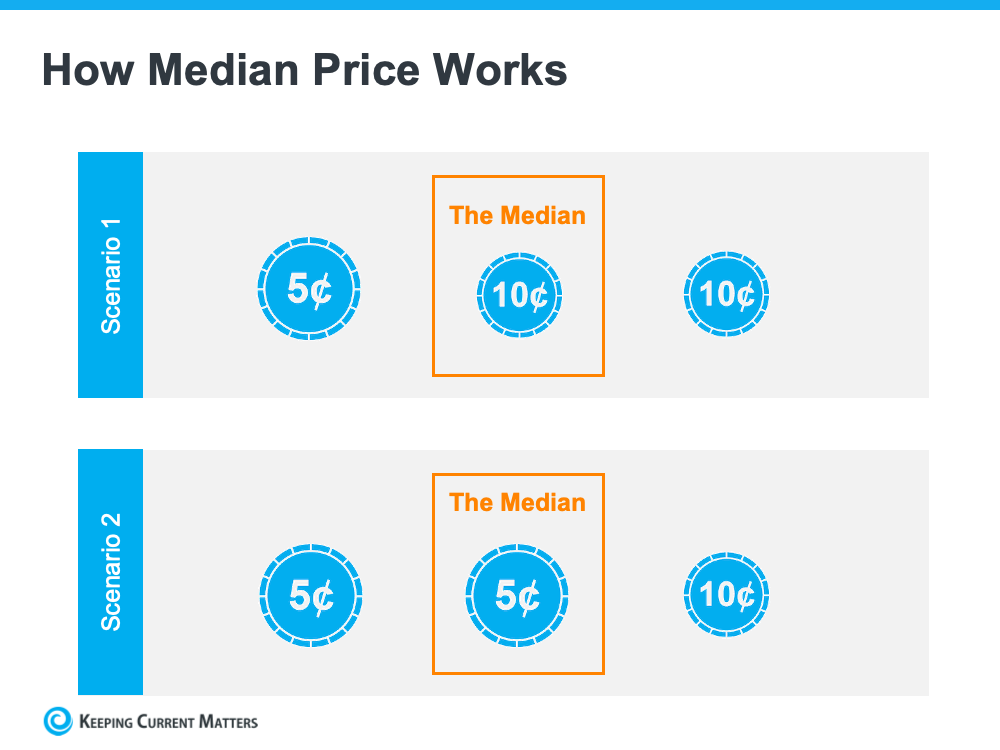
A Simple Explanation of Median Value: To illustrate the point, let’s consider a simple example using coins. Suppose you have three coins in your pocket—two nickels and one dime. If you arrange them in order of value, from lowest to highest, the median value would be 10 cents. However, if you have two nickels and one dime, the median value becomes five cents.
In both cases, the value of each coin remains the same: a nickel is worth five cents, and a dime is worth 10 cents. The change in median value does not reflect any actual change in the value of the individual coins.
The Relevance to Home Prices: This analogy emphasizes that relying on median home prices to gauge changes in home values may not be reliable at present. Most homebuyers evaluate prices to determine if they align with their budgets. However, their decision-making process is primarily influenced by the monthly mortgage payment they can afford, rather than just the price of the house. When mortgage rates are higher, buyers may opt for less expensive homes to maintain affordable monthly housing expenses. Consequently, there is an increased number of “less-expensive” houses being sold, leading to a decline in the median price. However, this does not signify a loss of value in any individual home.
Conclusion: When media reports indicate falling prices based on the upcoming release of the EHS report, it’s crucial to remember the coin analogy. A change in median price does not imply declining home prices. Instead, it indicates that the mix of homes being sold is influenced by factors such as affordability and current mortgage rates.
For a comprehensive understanding of home price trends and reports, it is advisable to consult with a local real estate professional who can provide valuable insights tailored to your specific market.
*Info provided by Keeping Current Matters
 LK Marketing and Real Estate
Leave a comment