If you’re in the market for a new home, staying informed about real estate trends is crucial. Lately, discussions about investors and their influence on the housing market have likely caught your attention. Questions may arise: How many homes do investors really own? Are large Wall Street firms dominating the market to the extent that it’s challenging for the average person to find a home? In this post, we’ll delve into the data to uncover the true story behind the headlines.
Understanding the Landscape
Let’s begin by examining the total number of single-family homes (SFHs) in the United States, which stands at eighty-two million, according to SFR Investor, an authority on the single-family rental market. Of these, approximately sixty-eight million (82.93%) are owner-occupied, leaving around fourteen million homes designated as single-family rentals (SFRs).
But do institutional investors own all fourteen million of these remaining homes? Far from it. Investors can be categorized into four groups:
- The mom & pop investor (1-9 SFRs)
- The regional investor (10-99 SFRs)
- The smaller national investor (100-999 SFRs)
- The institutional investor (over 1,000 SFRs)
Dissecting the Numbers
Contrary to popular belief perpetuated by media and social platforms, the majority of rental homes are not owned by large institutional investors. The chart below illustrates the percentage distribution of rental homes among these investor categories:
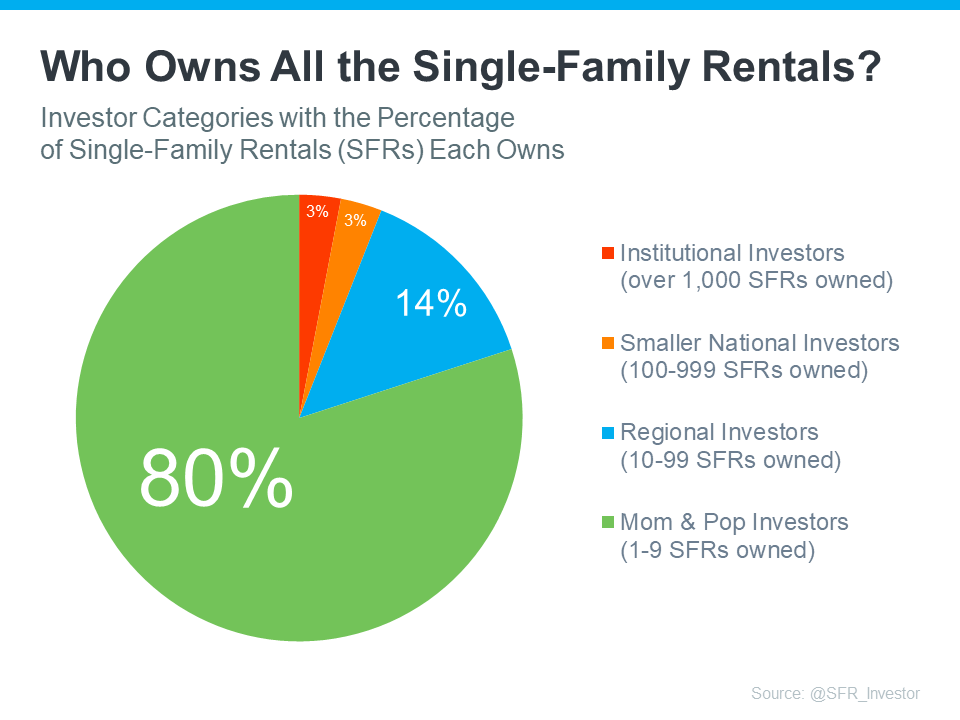
As the chart reveals, the green portion signifies that the vast majority of rental homes are owned by small mom-and-pop investors—individuals akin to your friends and neighbors. The reality is that people like you, who value homeownership as an investment, play a significant role in the housing market. Many have seized opportunities to purchase second homes for rental income or have chosen to retain their primary residences when moving up.
Dispelling Misconceptions
Contrary to sensationalized narratives, institutional investors are not acquiring all available homes, creating barriers for the average buyer. In fact, they represent the smallest segment in the pie chart.
Bottom Line: Seek Expert Guidance
While institutional investors do contribute to the single-family rental marketplace, they are not the sole players shaping the housing landscape. If you have questions or concerns about the housing market, consider reaching out to a trusted real estate professional. Their expertise can provide the context you need to make informed decisions in this dynamic environment.
*Info provided by Keeping Current Matters
 LK Marketing and Real Estate
Leave a comment